Key Takeaways
- •A CFO learns at 11:47 PM that a vendor is under investigation. She needs to act now.
- •One email to the ERP freezes $2.3M in payments. 30 seconds. Done.
- •In a legacy ERP, the same outcome takes ~36 hours of people-coordination, and $1.8M still goes out the door. Permanent rule changes? Add 2-4 weeks of IT.
- •Full audit trail comes free. Authorization, reasoning, proof. All logged automatically.
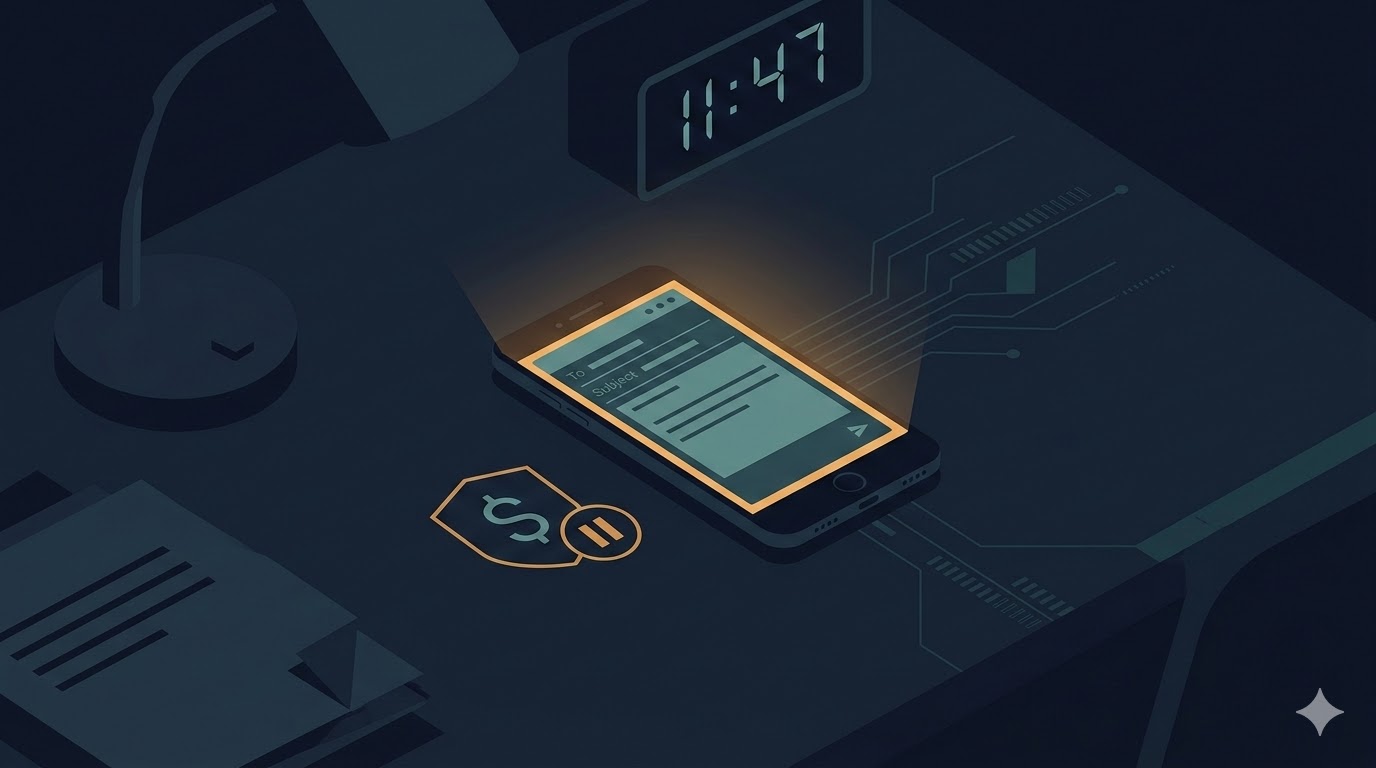
11:47 PM on a Monday
We talk to a lot of CFOs. One pattern comes up over and over: the moment you need your ERP most urgently is the exact moment it's least accessible.
Picture this. A CFO is scrolling through news on her phone before bed. A headline stops her: DataFlow Systems, one of her company's technology vendors, is under federal investigation for billing irregularities. Multiple clients are named. Her company isn't one of them. Yet.
She knows what's coming. Tomorrow morning: call the Controller, who emails AP, who pulls every DataFlow invoice, cross-references pending payments, loops in Legal, then manually freezes each one. If there's a payment run scheduled before the team gets to it? Money flows out to a vendor under investigation. And nobody's awake to stop it.
She has the authority. The system has the data. But at 11:47 PM, there's no bridge between them.
What if she could just... email the ERP?
With Eka360's Communication Intelligence, she can. She opens her email app on her phone and types:
Immediate — freeze all DataFlow Systems payments
I just learned DataFlow Systems is under investigation for billing irregularities. Effective immediately, freeze all pending and scheduled payments to DataFlow Systems. Any new invoices from them should be held for my personal review. Set a reminder to revisit this in 30 days.
No VPN login. No IT ticket. No chain of phone calls. Just plain English, the same way she'd instruct her Controller. The natural language workflow engine handles the rest.
30 seconds later
Eka360 receives the email, verifies it's really the CFO (SPF/DKIM authentication + role-based access), parses the instructions, and executes. Here's what the confirmation looks like:
Eka360
Processed in 4 seconds
Payment hold placed on 3 pending payments ($47,200) and 2 scheduled payments ($2,253,000)
Approval rule created: "All DataFlow Systems invoices require CFO approval"
Report generated: DataFlow Systems — 12-month payment history, contract summary, open POs
Reminder set: Review DataFlow freeze — April 16, 2026
Confirmation email sent to cfo@company.com
Slack notification sent to #accounts-payable
Audit trail logged with full reasoning and authorization chain
By 11:48 PM, $2.3 million in vendor payments are frozen. The AP team will see a Slack notification first thing in the morning. The CFO has a confirmation on her phone. She puts it down and goes to sleep.
Every action is logged with a complete audit trail. Who authorized it, what was executed, why, and when. That's what the AI Engine produces for every decision: the action, the explanation, and the confidence score.
Now imagine the same scenario without this
Same CFO. Same news. Same urgency. Here's the people-side of a legacy ERP response:
- •Monday 11:47 PM: CFO texts the Controller. Controller is asleep.
- •Tuesday 8:15 AM: Controller sees the text, emails AP. AP Manager is in a meeting until 10.
- •Tuesday 10:30 AM: AP Manager pulls up DataFlow in the ERP. 5 open items across two entities. Are any in a payment batch?
- •Tuesday 11:00 AM: Bad news. A $1.8M payment was in Tuesday's batch, submitted at 6 AM. It's already processing.
- •Tuesday 11:15 AM: AP calls the bank for a wire recall. "3-5 business days to investigate."
- •Tuesday 2:00 PM: Remaining payments manually frozen. Controller loops in Legal. Legal asks for a 12-month vendor report. AP starts pulling data.
- •Wednesday: Report delivered. Wire recall still pending.
That's ~36 hours, 5 people (CFO, Controller, AP Manager, AP Analyst, Legal), and $1.8M already out the door. No clean audit trail either, just a chain of texts, emails, and verbal instructions that nobody documented.
And here's the part people forget: that's just the people-side. If the CFO also wants the ERP to permanently enforce "hold all future DataFlow invoices for my review," that's a system configuration change. File an IT ticket, wait for a BA to spec it, a developer to build it, QA to test it, and a change board to approve it. Add 2-4 more weeks.
Legacy ERP
36 hours
people-side only
+ 2–4 weeks for system rule change
5 people · $1.8M at risk · no audit trail
Eka360
30 seconds
actions + rule change
1 person · 1 email · $0 at risk
full audit trail included
Response time = financial exposure
Vendor fraud, billing irregularities, supply chain disruptions. These aren't edge cases. They happen all the time. And when they do, the gap between "CFO decides to freeze payments" and "payments are actually frozen" is pure risk.
In legacy systems, that gap is filled with waiting. Waiting for people to wake up, check their email, get out of meetings, log into systems, follow manual processes. Every hour of delay is another hour of exposure.
We think that gap should be zero.
The audit trail nobody had to write
This is the part that really matters to Controllers and auditors. Everything Eka360 did in this scenario is permanently logged:
- •Authorization: CFO email authenticated via SPF/DKIM, role verified as payment-control authorized
- •Intent parsed: "Freeze all pending and scheduled payments to DataFlow Systems" — confidence 98%
- •Actions executed: 5 payments held, 1 approval rule created, 1 report generated, 1 reminder set
- •Notifications: Email confirmation to CFO, Slack to #accounts-payable
- •Reasoning: Natural language explanation of each action and why it was taken
When an auditor reviews this six months later, there's nothing to reconstruct. The email is the instruction. The log is the proof. Compare that to the legacy scenario, where you'd need to piece together a text message, three emails, a phone call to the bank, and someone's memory of a hallway conversation.
It's not just emergencies
We picked a dramatic example here to make a point. But the underlying principle is mundane: your ERP should work the way you already work.
CFOs don't live inside ERPs. They live in email, Slack, and back-to-back meetings. The decisions they make happen in those channels. So the ERP should be there too.
The same architecture that freezes $2.3M at 11:47 PM also handles the routine stuff: approving a budget reallocation from a Slack message, pulling a variance report via email, updating a vendor payment term with a single sentence. Different stakes, same principle. The ERP participates in the conversation instead of waiting for someone to log in.
Where we stand
A CFO's authority shouldn't be limited by system access, business hours, or IT queues. When a financial decision needs to happen now, the system should execute now. With a full audit trail, proper authorization, and complete transparency.
That's the kind of ERP we're building. Not AI bolted onto a legacy system. AI as the execution layer, understanding natural language, validating authority, taking action, and explaining every step.
$2.3 million. 30 seconds. One email.
That's the difference.
Note: This is a hypothetical scenario written to illustrate how an AI-native ERP can handle urgent financial controls through natural language. The vendor names, amounts, and individuals are fictional. The underlying capabilities — email-based instructions, automated payment holds, natural language rule creation, and audit trail generation — reflect the architecture we're building at Eka360.